


Categories

Blog

Explore
The Foundation Stone Haggadah: Kadesh 6

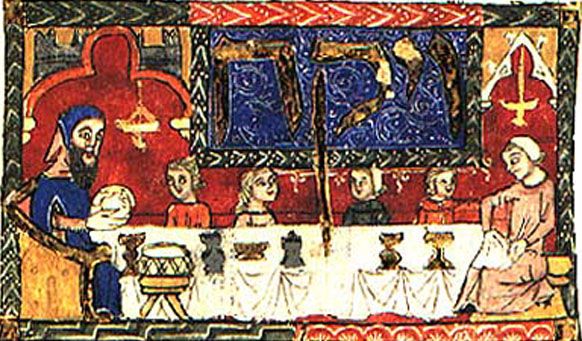
The Seder begins with Kiddush. This Kiddush is not only that which we recite at the beginning of every Yom Tov meal. It is one of the steps of the Seder. As it is the first of the fifteen steps, it must introduce the...
Explore
Forms of Prayer : A Conversation

I do not like the usual definitions of the different forms of prayer. There are times I plead with God, others when I pester, or argue, demand, rejoice, reason, sigh, praise, express love, use confidence, or kvetch. I find each approach effective in its proper context.
Explore
The Foundation Stone Haggadah: Themes of the Haggadah 11

The first paragraph after “Ma Nishtana” reads, “…the more one speaks about the Exodus from Egypt, the more he is praiseworthy.” The Ishbitzer Rav has a very interesting reading of this statement. He says that wherever we speak of speaking, the less you say,...

Explore
The Foundation Stone Haggadah: Themes of the Haggadah 8

The Vilna Gaon says that the number that occurs over and over on Pesach night is the number four. We have four cups of wine, four sons, four questions, etc. Why is four so repeated? He answers that there are four types of people...

Explore
The Foundation Stone Haggadah: Themes of the Haggadah 7

On Chanukah and on Purim we make the blessing, “Who made miracles for our fathers in those days, and [who] also should [make miracles] in these times as well.” Rav Amram Gaon asks why don’t we say this blessing on Pesach since more miracles...

Explore
The Foundation Stone Haggadah: Themes of the Haggadah 6

There is an interesting debate between Rambam and Raavad. When we eat the Matza we make two brachot. First we say Hamotzi, and then we say Al Achilat Matza. Rambam says not so. This is wrong. In fact, all of us are doing it...

Explore
The Foundation Stone Haggadah: Themes of the Haggadah 5

Some say that we should read this verse as, “My father was a wandering Aramean,” where ‘my father’ refers to Laban. After all, we are all descendants of Laban. Think about it. Jacob had four wives and they are the mothers of all twelve...

Explore
The Foundation Stone Haggadah: Themes of the Haggadah 4

The Mishnah says that when a child asks his father the Ma Nishtana, the father answers with praises of God. To do so, he should begin with something negative and contrast it with something positive. However, the Mishnah doesn’t specify which texts to use...

Explore
The Foundation Stone Haggadah: Themes of the Haggadah 3

After the Exodus, the Jews enter an entirely spiritual existence. God feeds them, they live at the base of Mt. Sinai, and they perfect themselves until they are equal to Adam and Eve before the sin. As they are to accept the Torah, they...

Explore
The Foundation Stone Haggadah: Maggid 1

I’d like to read you a Zohar about Magid. “After the mitzva of Matza, God gave the Jews the mitzva of praising God for the Exodus, which is the obligation of anyone who is the son of a woman to speak these praises forever....

Explore
The Foundation Stone Haggadah: Maggid 2

There’s happiness in this world, and happiness in the Heavens. But there’s more. “And now, the power of Heaven increases because there is only joy in Heaven and joy on Earth.” In this way, by the Jews telling the story of the Exodus, they...

Explore
The Foundation Stone Haggadah: Reb Tzaddok: Rachtza

Rav Tzadok Hacohen of Lublin asks, why do we say, “…who sanctified us with His commandments,” before we perform a mitzva? He answers that it is because object of the mitzvot is to sanctify us, or to allow ourselves to be sanctified. Again, what...

Explore
The Foundation Stone Haggadah: Mozti Matzah

We make two blessings. The first is “Hamotzi Lechem Min ha’Aretz,” as we are about to eat bread, and we also say, “Motzi Matza,” because we going to eat matza. Since we say two brachot we must eat two olive-sized portions of matza. Therefore,...

Explore
The Foundation Stone Haggadah: Rachtza – Motzi Matzah

When we say “Hamotzi Lechem Min ha’Aretz,” we are saying that we want to learn how to live on a higher level. Do you see how this develops from the way I explained Rachtzah? Rachtzah is how you learn to live free in this...

Explore
The Foundation Stone Haggadah: Matzah 2

Apparently, eating Chametz is very dangerous and it makes sense not to eat it. So why do we eat an offering on Shavuot that is made almost exclusively of Chametz? In the words of the Zohar, if we are not allowed to eat Chametz...

Explore
The Foundation Stone Haggadah: Marror 1

Maror is obviously a symbol of suffering. It is interesting that Pesach is a bittersweet experience. “It is taught: R. Shimon bar Yochai said: There were three gifts that G-d gave the Jews, but each of the three could only be acquired through suffering....

Explore
The Foundation Stone Haggadah: Marror 2

“Originally our fathers were idol worshippers…” Then, we quote Joshua in which he speaks to the Jews after they have successfully conquered Eretz Yisrael. He says, “So says Hashem, God of Israel: Your fathers dwelt beyond the Euphrates river, Terach, the father of Abraham...

Explore
The Foundation Stone Haggadah: Yachatz

What do we do in Yachatz? We take the Matza and we break it down the middle. Which Matza do we break? – The middle Matza. If we say that the top Matza is Abraham and the bottom Matza is Jacob, then the middle...

Explore
The Foundation Stone Haggadah: Freedom

True Freedom If you want to have a relationship with God, then you must make choices. The only thing that frees you and frees me (and we’ll see later, the greatest freedom) is that we have a relationship with God. Otherwise we are stuck...

Explore
The Foundation Stone Haggadah: Why Did God Free Us?

We speak of two reasons why God freed us. In one place we read that God freed us because He heard our cries, had mercy, and He loved us. It broke His heart, so He needed to take us out. A few paragraphs later,...

Explore
The Foundation Stone Haggadah: Karpas 4

In his Haggadah Simchat HaRegel, Rabbi Chaim Yosef David Azulai (or, Chidah) quotes Rabbeinu Manoah who wrote a commentary on Rambam. In it, Chidah says that Karpas is a mneumonic of Ketonet Pasim, the coat of many colors, given to Joseph by his father...